
3 min read
God in the Code: How Leibniz Saw AI Before Computers Existed
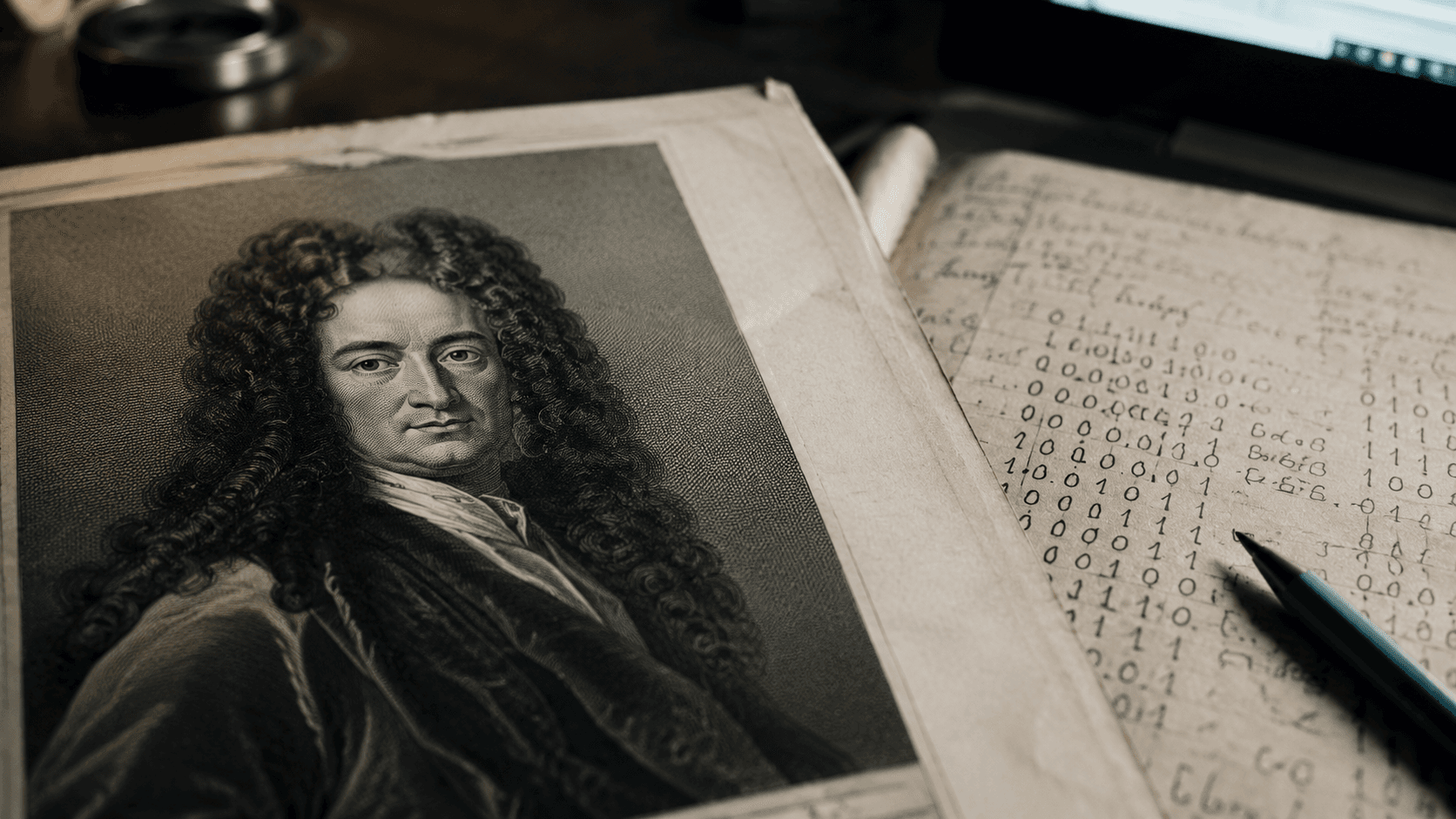
Would it be a surprise if I said that the code behind AI was not originally designed for computer science? All the Zeros and Ones we find in the AI universe were actually first metaphysical principles tied to existence–God (1) and the void (0). Gottfried Wilhelm Leibniz, an eighteenth century mathematician and philosopher wrote an article called "Explanation of the binary arithmetic, which uses only the characters 1 and 0, with some remarks on its usefulness, and on the light it throws on the ancient Chinese figures of Fu Xi." It was through this article and other writings that Leibniz identified the foundation of today’s modern computing. Every piece of code that exists which includes every digital file, and every bit of information on our devices ultimately reduces to Leibniz’s idea of Ones and Zeros, however; the “father of computer science” was not thinking about computers nor Artificial Intelligence, but the Great Intelligence that created the universe out of nothing.
Leibniz found profound meaning behind this binary system in which “One” represented God, existence, unity and being. The number one was the fundamental principle of reality–to be is to be one was to be a single and complete substance. “Zero” represented the void–nothingness. Zero was the absence of being, but it was also the potential for existence to arise. His belief was that if nature could be translated into these binary numbers, humanity would be able to attain perfect knowledge. Knowledge of what? Knowledge of the duality of being and non-being, existence and non-existence, and ultimately God and creation.
Many of those behind AI today, and in computer sciences no longer share the same ideas of their founder Leibniz who wanted to show a harmony between metaphysics and emerging mathematics/computation. His views theologically saw number One as the ultimate unity, the source of all creation like we read from Deuteronomy 6:4:
“Hear, O Israel: The Lord our God, the Lord is one.”
He as well was very much in line philosophically with Saint Thomas Aquinas who explained in his Summa Theologica that God’s oneness is absolutely simple and undivided. St. Thomas wrote that God’s oneness is the highest perfection and supreme unity, and the source of everything, similar to what Leibniz thought.
Technology companies today approach technology with a mechanical (lifeless) mindset, eliminating altogether the metaphysical reality and meaning, but as it has already been shown above, Leibniz knew better, and his original concept of Ones and Zeros reflects a cosmos governed by a Divine Creator. Acutis celebrates the advancements made by mathematics, science and technology that have designed amazing tools, but the platform does not agree with the materialistic views that so many hold today. Acutis recognizes and believes in the truth of the universe’s Designer who makes all life possible which is the cornerstone of the platform. We invite everyone whenever they are on their computers or smartphones next, to take a moment to reflect on how technology reflects Divine order, and to pray that technologists remember the God behind the code they write.
Joseph Daniels
Acutis AI Writer