5 min read
Busy Doing Nothing - How Technology Steals Real Leisure
It seems that for many of our families, technology has made all our lives better. One could even say A LOT BETTER, and why would we not think this? Technology is great. It is doing so much for us like giving us more time to be productive, but even more valuable–more time to relax. This is one of technology's greatest benefits. It does the work that we do not want to do, and it does it better and faster so we have time for ourselves. Today, AI goes even one step further–we do not even need to think. AI will do that for us too. There is no need to be creative anymore–AI will paint us a masterpiece. Time spent on writing an article that could take hours can now be done in seconds by AI. Our life is easier today than 100 years ago. WITHOUT A DOUBT! Hard work? That is becoming something of the past. So if technology is doing more of the toilsome work for us, even the artistic kind, what are we going to do with all this free time?
Not to be dramatic, but remember what humanity looked like in the Wall-E movie? Looking past their obesity (which is another real problem we face today), let us focus more on their behavior or lack of. With technology doing ALL the work, those living on the ship did not even need to turn their heads to dispose of their garbage nor swing a racket with their arms in tennis. As long as they kept their eyes on their screens, technology did everything for them, giving them all the time to be at leisure. Humanity being fully integrated with technology does seem to offer a “leisurely life” with nothing to worry about, but is that really the case? Looking at our life today. Are we really gaining more leisure with less work that is now being done by today’s technology? Were those in Wall-E really in leisure?
It is highly recommended to read Josef Pieper’s book, Leisure The Basis of Culture, and to complement it by watching the documentary on EWTN: Beyond the Machine which discusses Pieper’s ideas in modern day. Josef Pieper was a 20th-century Catholic philosopher who after World War II, wrote his book expressing why leisure is essential for us to flourish. For so many of us, we believe leisure is doing nothing or being idle. This is wrong, says Pieper, and in the documentary, we learn an even bigger modern error is how many of us think “leisure” can be spent behind the screens. Take a moment and look at these brain scans of teenagers1:
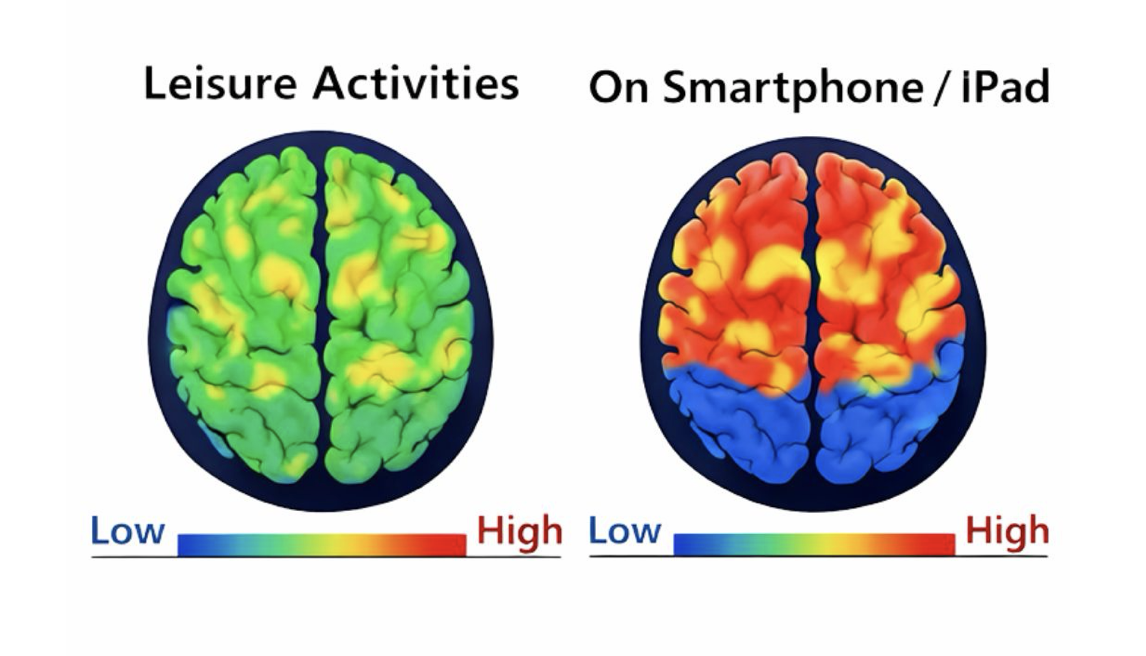
These scans are being taken at specific moments. The one on the left is a person at leisure. The scan on the right is the brain while on a smartphone or smart device. It is clear from these scans that when we are on our smart devices, our brains are nowhere near rest. More and more studies are coming out that show how screens are overworking our brains, causing dopamine dumps (it's addictive–like taking a hit of drugs), and activating the brain at such fast paces that it is causing us more stress, anxiety and depression. Now if we look and compare the brain at leisure, we see that it is not hard at work, but many of us would think that this brain is a rest (doing nothing). We would still be wrong. Look at the brain scan that is at true rest:
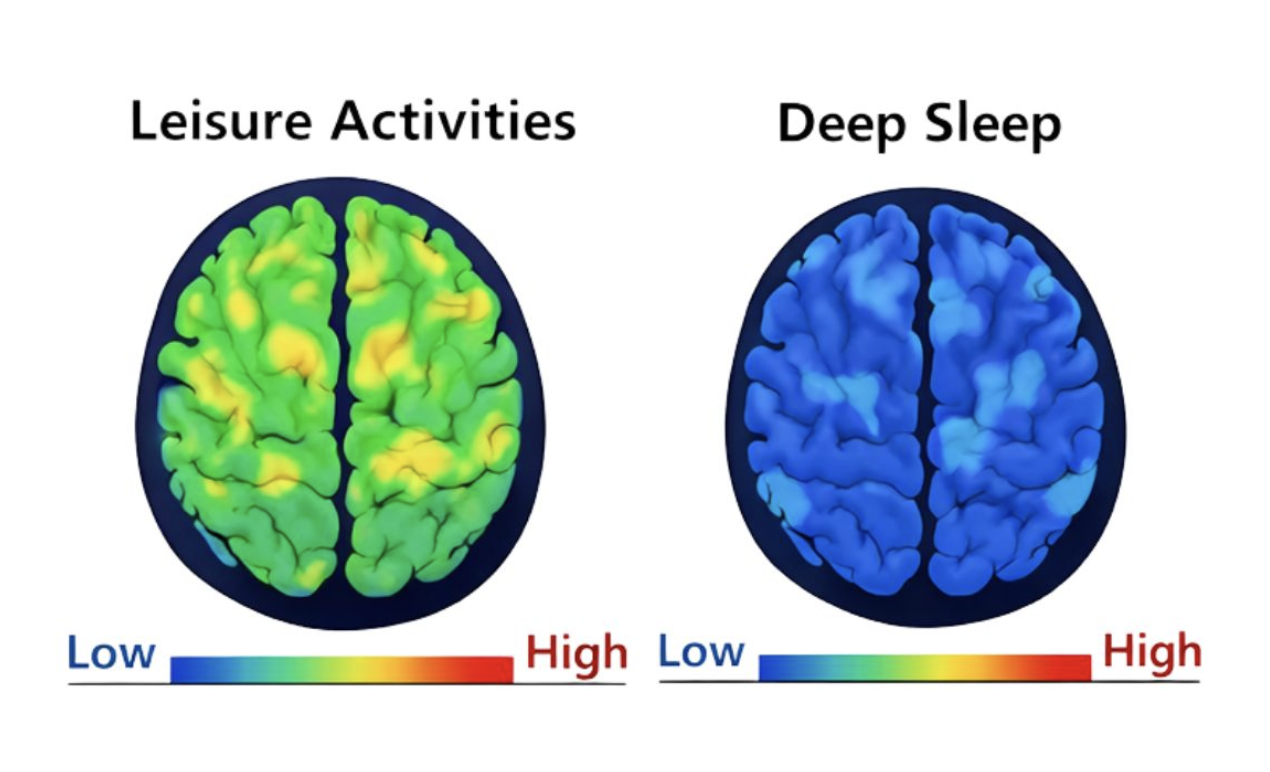
By looking at these scans, we see that the one on the right (sleeping) is not the same as leisure. Being in a state of leisure is actually an activity that is stimulating the brain–it is not a brain doing nothing. So what is leisure doing?
True leisure we are told by Pieper in his book is what is “always at play, playing through the whole world” (Prov 8:30). It is like having the eyes of a playful child who is in wonder, receiving everything for the first time. It is a state in which we are passive, but not lazy. We passively receive what the world around us has to offer. There is little effort in leisure, but this does not mean that we are idle. What we are really doing is creating a space to be able to contemplate, and have time for inspiration to jolt us, leading to acts of creation like beautiful art for example. Josef Pieper also teaches us that leisure is at its core a celebration of life, and what better celebration to have than to worship God who is the Creator of life.
Does the description above sound like anything we are doing in our home with our technology or what humanity was doing in Wall-E? Are we in awe of it all? Are we celebrating life by celebrating God? Are we resting like God instructed us to do?
Technology has a lot of benefits like doing the work we do not want to do, but when screens occupy the majority of our free time, we cannot do what God wants for us. It should be no surprise that technology companies and various platforms are not concerned with our relationship with God. They want us to form a relationship with technology. There are even stronger signs of dependence on technology today. How often do we hear people now using AI for everything: homework, emails and even simple text messages? Less and less time is being spent in contemplation and being creative–this is what Pieper and many others are concerned about.
This does not mean that technology is the enemy, but when it is used to avoid God, it is. There is a lot to be discussed here and there will be more articles to come that will discuss our relationship with technology, and also our relationship with leisure. For now, let us end here with what we have already learned with three great ways to start using our time that technology gives us by living real leisure:
-
More time for prayer. First, do not pray with the phone. Find a quiet place. This can be early in the morning or in the evening before bed. Take time with God. Pray, but also listen. Quiet ourselves the best we can. This is not easy and we will find it hard at first, but like anything else, it takes practice. Also, find time to pray as a family. Pray the Rosary together. Spouses can pray at night together before they go to bed. Also, and most importantly, make sure we are going to Mass on Sunday and it is not a bad idea to turn off the phone–it's only one hour.
-
More time for contemplation. Do not put anything in front of us except what it is we want to contemplate. This could be our Lord at Adoration or it could be just a beautiful sunrise or sunset. The trick here is to not allow ourselves to think about it. Just let it come to us. Be passive and receive what is in front of us. This is the beginning of what contemplation is. One great example is when we just listen to the waves of the ocean and watch as the waves come in and out–nothing else.
-
More time for family. Put down the devices and spend time face to face. Nothing to talk about? Silence is not bad, but try to be creative. Think of questions to ask. Think of stories to tell. Jokes and anything in between. The point is to not have screens distracting these moments. NO DEVICES AT THE DINNER TABLE. Could we imagine Christ breaking the bread and saying, “This is my body…‘Ring Ring’…oh sorry, I got to take this real quick.”
We at Acutis pray that all of us with our technology find harmony between using what can be good with our tech and leave the rest so we can love God and love neighbor.
God bless
Joseph Daniels
Acutis Writer
Article inspired by Gabriella Howard Mastrangelo