
5 min read
Creating to Glorify God vs. Creating to Replace Him
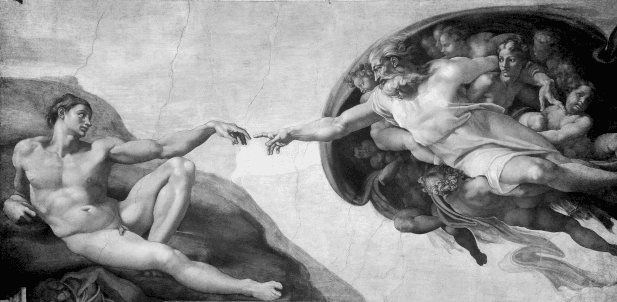
In past centuries, many leading scientists were monks, and groundbreaking discoveries emerged from monasteries. The most beautiful art depicted God, and the most grandiose buildings were churches. Today, breakthroughs come from research labs and corporations. Paintings were once unsigned; now they draw their price from the name in the corner. We raise new cathedrals of concrete and glass, not to honor the divine, but to display corporate power. What happened?
In the past, art was created as a tool for worship, with the intent to help people contemplate the divine. Scientific research was conducted to better understand humanity so as to understand God more deeply. 16th c. astronomer Johannes Kepler described his work as “thinking God’s thoughts after him.” The pursuit of truth, goodness, and beauty once drove progress, with research and art carried out with an upward gaze.
Over time, that gaze has shifted. Discovery, which was once the means, became the end, fueled by hopes of monetization or renown. As Western societies became secularized, they began to see the world as a closed, empirical system. Science defined what the world was and technology managed it. Faith and reason were divorced. Because of this, religion became a weekend activity which catered to people who needed something to believe in or be a part of. Today, “progress” is driven by the ancient temptation, “You will be like God.”
But how did this happen? Modern day philosophers like Weber and Ellul tell different stories, but one theme is clear. Our chins began to fall, and our gaze diverted from God to the world. We began to create with the desire to become Creators. Nietzsche famously theorized that we have killed God and as a result we must replace him. Followers, users, and customers became the worshippers of our self-made religions that called us god. The next step was almost obvious. We set out to engineer intelligence itself, fashioning a machine in our image that bows to our every desire.
According to a 2025 Pew Research study, 50% of Americans are more concerned than excited about AI. This fear is uniquely intense in comparison to reactions toward past technological advancements. But what if AI was built with a different purpose? Designed not to enthrone us, but to help us see more clearly, serve more faithfully, and better understand the One whose image we bear.
At Acutis, we build not to become creators in His place, but to create in His image, so that through understanding the world, we may come to love its Author more fully.